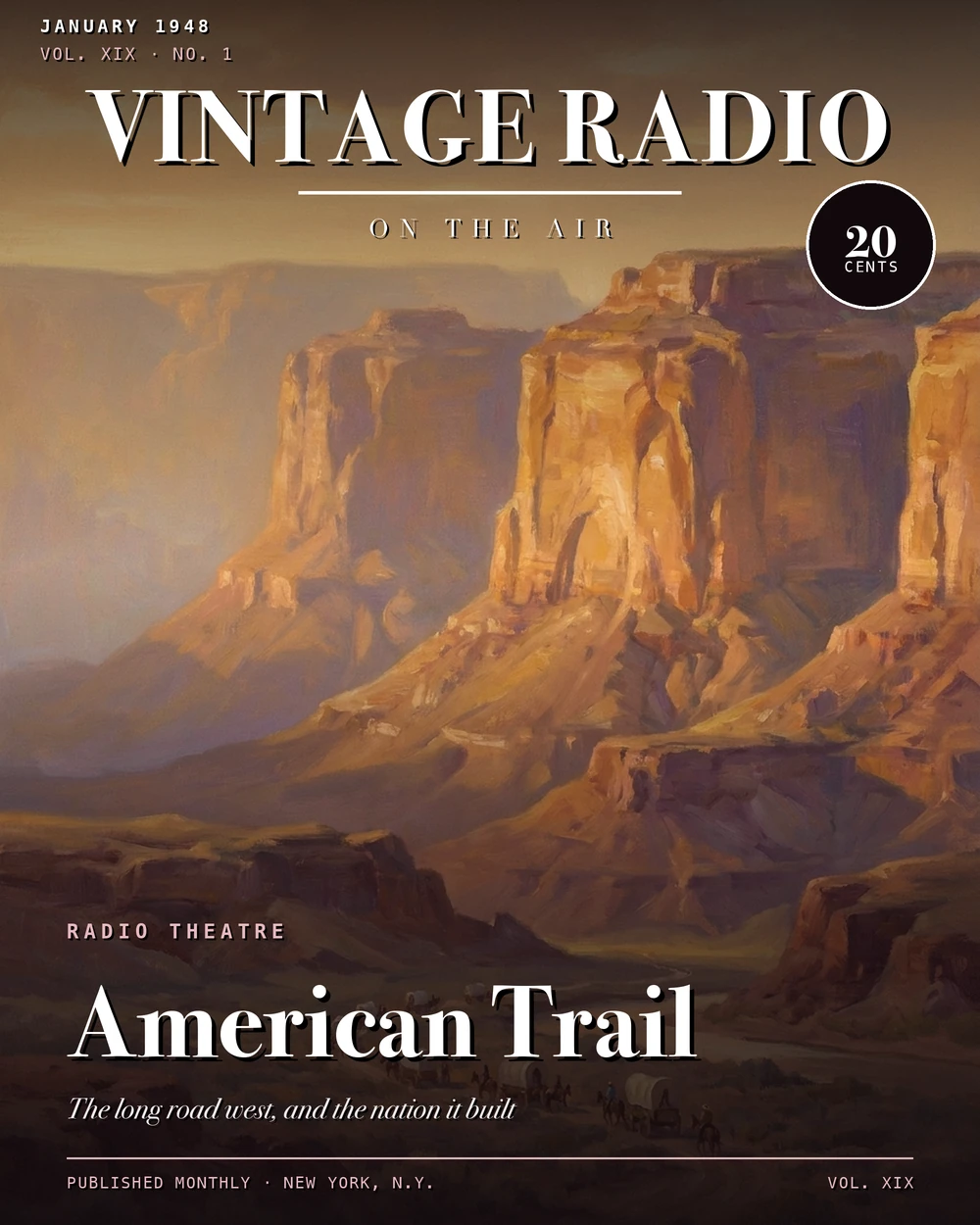
American Trail
History as Drama, Fifteen Minutes at a Time
American Trail arrived on radio in 1953 as something genuinely unusual: a 13-part adventure serial that took the history of the United States seriously as dramatic material. Each episode ran exactly fifteen minutes — tight enough to hold a young listener through a school lunch break, substantial enough to cover real ground. The series described itself as a "historically correct serial-drama," and that phrase captures its balancing act pretty well. It wasn't a classroom lecture dressed up in sound effects, and it wasn't a shoot-'em-up that happened to mention a few real names. It sat somewhere in between, pushing the action forward while staying anchored to actual events and places.
The show covered the kind of American history that genuinely lends itself to radio adventure: the Lewis and Clark Expedition, the California Gold Rush, the Louisiana Purchase, the settlement of the West. These weren't framed as textbook moments but as stories with suspense, movement, and consequence. With a total runtime across all thirteen episodes of roughly three hours and eight minutes, the complete serial is almost exactly the length of a feature film — and it was conceived and produced with something like that shape in mind.
The Sponsor Behind It
The VFW Ladies Auxiliary — formally the Ladies' Auxiliary to the Veterans of Foreign Wars — sponsored American Trail, and that backing shapes a lot of what the show was. This wasn't a soap company looking to move product between drama scenes. The Auxiliary had a civic mission, and a program about American history, aimed at young audiences, fit that mission directly. The sponsorship gave the production a particular character: the show carried the implicit weight of an organization that had earned its seriousness, and the content reflected that. The series was aimed particularly at middle-school-aged listeners, though it drew a broader audience than that, as radio shows with strong storytelling tend to do.
That civic framing also helps explain how the show could attract the caliber of contributors it did. Notable public figures appearing in the series included Bing Crosby, General James Doolittle, and President Dwight D. Eisenhower — names that brought genuine credibility to the project and signaled that this wasn't a purely commercial entertainment venture. Getting a sitting president to participate in a radio serial is not a routine achievement, and it reflects how seriously the production was taken by people in a position to lend it their names.
What the Episodes Covered
The thirteen episodes of American Trail moved across a wide span of American history and geography. Some followed the great westward movements — the Lewis and Clark Expedition pushing through unmapped territory, the California Gold Rush pulling fortune-seekers across the continent. Others turned to the industrial and political transformations that built the country: the Louisiana Purchase that doubled the nation's size, Samuel Slater's machinery that seeded American manufacturing, the telegraph line suggested by the episode titled "The Magic Wire."
Other titles point to stories that ranged from the desert Southwest ("The Rich Desert") to the Pacific coast ("On To Montarey"), from the post-Civil War South ("The New South") to the open sky ("The Blue Younder"). "Dispatch From NY" and "The Northwest Trail" round out a series that was clearly trying to cover American history with genuine range, not just the most familiar moments. The effect across thirteen episodes is something like a compressed survey course — but one built around suspense and forward momentum rather than summary and analysis.
The Way It Sounded
American Trail used the standard toolkit of dramatic radio: a narrator moving the story forward, character dialogue advancing the action, sound effects grounding scenes in physical reality, and music threading through to carry emotion. The narrative style was interspersed rather than purely sequential — the writing mixed dramatized scenes with more direct historical material, letting the two modes reinforce each other. A passage of narration establishing the stakes of the Lewis and Clark journey would give way to voices and ambient sound that put listeners on the trail itself.
Fifteen-minute episodes impose a particular discipline. There's no room for leisurely scene-setting or long character arcs. Every minute needs to pull its weight, which tends to produce writing that moves fast and trusts the audience to keep up. For a show aimed partly at younger listeners, that pace was probably part of the appeal — the stories didn't drag, and the historical context arrived embedded in the action rather than front-loaded before anything interesting happened.
Where It Fits
American Trail sits comfortably alongside other programs that used radio's dramatic power to tell American historical stories — shows like Cavalcade of America, Destination Freedom, and You Are There, all of which tried in their own ways to make the past feel present. OTR researchers have grouped it in this tradition, and the comparison holds up. The show also gets placed alongside Death Valley Days, Frontier Town, and Gunsmoke for its focus on the American West, though American Trail covered more historical ground than a straight Western.
The comparison to shows like The Man Called X and Captain Midnight is more about approach than subject matter — the shared technique of braiding factual accounts into adventure narratives. American Trail was a short run, thirteen episodes in a single season, and it didn't become a long-running franchise. But a Certified Complete set (Version 2, released November 29, 2017) means the series survives intact — all known circulating episodes accounted for, the full story available. For a show from 1953 with a single short run, that's a meaningful piece of luck.